
Articles
Filter by: Date, Finance, Inheritance, Litigation, Property, Rental, Residency, Taxation, Uncategorized

Advice to Struggling Mortgage Borrowers in Spain
Raymundo Larraín Nesbitt, March, 8. 2011
Ex-pat landlords are still struggling to remain afloat in 2011. This article provides them with some useful tips.
By Raymundo Larraín Nesbitt
Lawyer – Abogado
8th of March 2011
Introduction
From a global perspective, political instability in the Middle East has sparked tensions fueling oil prices to new record highs. The Japanese tragedy has set the stage for a further rise in commodity prices needed to re-build the country which were already at all-time highs due to China’s ongoing real estate bubble. This in turn has brought a surge in inflation (rise in the general level of prices of goods and services). As a result the European Central Bank is juggling on the one hand unchecked inflation and on the other the budding recovery of an ailing European economy straggled by peripheral economies which in turn are debt-laden. The ECB, de facto heir of the Deutsche Bundesbank, has a mandate to keep inflation at bay. As a result of this commitment it announced it will hike the official interest rate as of April with more hikes to follow along the year.
The problem is that on doing so you run the risk of derailing the budding European recovery spearheaded by Germany tipping the economy into a full-fledged double-dip scenario. So it’s really a matter of balancing priorities in Europe. Peripheral economies vs. export-oriented countries. The former, saddled with debt, will be the ones bearing the brunt of a rise of interest rate while the latter will reap the benefits. Mind you, a sharp rise in interest rates would also hurt the latter. The choice, seemingly, has already been made by the ECB.
The Euribor rate (to which most Spanish mortgages are referred to) has already risen in anticipation of the foreseen hike. This will translate into higher mortgage repayments. With hundred of thousands of Spanish mortgages already underwater this could not come at a worst time.
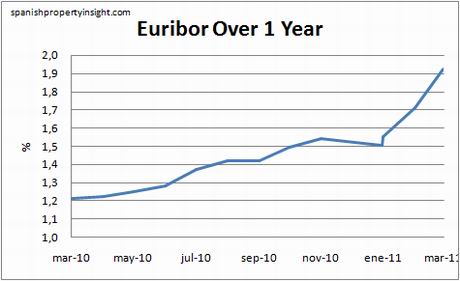
From a national perspective, the Spanish Government is bent on closing the ever-widening deficit having decided to clampdown on black money in an effort to prop up its dwindling coffers. As a result the AEAT (Spain’s equivalent to HMRC) will be taking a number of new measures such as cross-referencing with utility companies household consumption as from March to detect undeclared rentals which are rife in Spain. The afore measure will have foreseeable side effects.
Landlords with undeclared lets will now be faced with the grim prospect of either disclosing the let (maybe even raising it so as to offset rental taxes) or else continue at large running the risk of getting caught and fined by the local tax authorities. The afore is compounded and aggravated by the fact that ex-pat landlords normally use the rental income to offset their Spanish mortgage repayments. At a time when rentals vastly outstrip demand in Spain, and good-paying tenants are increasingly hard to come by, this couldn’t come at a worst time. It is doubtful a tenant will cave in to a landlord’s demand to raise the let to offset the associated taxes. The tenant will probably opt to move elsewhere as nowadays they will be spoilt for choice.
All the above will bring about additional headaches to already struggling ex-pat landlords. British will be particularly worst off due to the strengthening of the Euro against Sterling over the last couple of years.
With the above in mind, I’ve written this article in anticipation of the financial problems that are to come for many borrowers in Spain.
Tips to Struggling Mortgage Borrowers
1. Swap to interest-only (“carencia”). This can be arranged whilst the property is put up for sale or just to weather off the storm meanwhile. This option has become increasingly difficult post credit-crunch as Spanish banks seldom grant interest-only and when they do, it’s really just as a teaser for two years at most.
2. Extending mortgage repayments an additional number of years. The drawback is that on doing so the amount of interests you pay on the long run are increased dramatically. So it’s only an option for those left with no other really. The Government is now allowing this change free of charge to struggling mortgage borrowers providing they are resident and the property is their permanent dwelling. Borrowers will not pay for Notary or Land Registry fees on following it.
3. Dación en pago. This is basically handing over the keys back to the lender and signing a deed at the Notary whereby the lender commits itself not to chase you for the outstanding debt and considers it discharged for good. Two things are required, the property must not have slipped into negative equity and ideally there should be, as rule-of-thumb, at least 20% equity so as to offset the lenders’ expenses on taking over the property. It doesn’t matter if you are already in arrears, what does matter is that the repossession procedure must not have been started by the lender. Should the property be in negative equity (you owe more than what the property is worth) a lender will be very reluctant to agree to a “dación en pago de deuda” because the collateral will have no equity left. Please read my article Dación en Pago or Handing Back the Keys for more details.
4. Selling the property as a distressed asset. If you have already run through the numbers and you are convinced that you will no longer be able to service your mortgage, rather than defaulting and being repossessed, you should very seriously consider selling the property as a distressed asset. The catch again is that the property should not be in negative equity. The more it is the least likelihood there will be anyone interested in it as they in turn are regarding the purchase as an investment and the numbers need to stack up to make it worthwhile for them.
5. Applying for debt consolidation. There are many financial companies offering this service. Basically what they do is group together all your existing debts with different lenders (ranging from credit card debt to personal loans) with one lender who then extends the loan repayments. The consequence this has is that your monthly repayments are cut down significantly making them more affordable. However the drawback once again is that on extending the financial commitments you will be paying more interest over time.
6. Swapping the mortgage to a new lender. Many lenders are now offering to take on existing mortgages going as far as paying all the transfer expenses. Lenders will normally require the property was bought prior to 2003. This is because properties purchased before this date are deemed as “safe” (not in risk of being in negative equity). In addition, for those who hold collar clauses (“cláusula suelo”), swapping over to another lender offers the opportunity to get rid of these bothersome clauses and take advantage of the low interest rates. Moreover, new rulings have declared collar clauses as abusive (something which incidentally I had already pointed out in my article on 10 Common Abusive Clauses in Spanish Mortgage Loans). These rulings are forcing lenders to scrape them off their existing mortgage contracts within the next two months of the ruling as well as not to include them in new contracts.
7. Filing for personal bankruptcy in Spain. This procedure is expensive albeit it allows those who can afford it to buy considerable time (years) with which to re-negotiate your financial commitments and even reduce the amount owed (up to 30%). A judicially-appointed administrator will be tasked to oversee and manage your day-to-day financial affairs in the interim. Meaning you lose control over all your assets needing to request permission. I would only recommend this option in exceptional cases as it will turn you into a lifetime financial pariah. This is not an option for most people.
In Conclusion
My advice is to draw the red line on a repossession procedure. You should try to avoid this scenario at all costs. As the debt goes personally against the borrower in Spain, you may live a nightmare with debt-collecting agencies, banks or lawyers knocking at your door for years to come. As the compound default interest is fairly high this will be rolled up to what you already owe creating a mounting debt spiral.
A lawyer can help a struggling borrower to achieve the above tips successfully averting a debt spiral drawing a line to protect your family assets.
Larraín Nesbitt Lawyers, small on fees, big on service.
Larraín Nesbitt Lawyers is a law firm specialized in inheritance, conveyancing, taxation and litigation. We will be very pleased to discuss your matter with you. You can contact us by e-mail at info@larrainnesbitt.com, by telephone on (+34) 952 19 22 88 or by completing our contact form.
Legal services Larraín Nesbitt Lawyers can offer you
Related articles
- Lifetime Loans or Reverse Mortgages in Spain Explained – 21st February 2011
- Advice to Struggling Mortgage Borrowers in Spain – 8th March 2011
- Spanish Mortgage Loans: Beware of Abusive Clauses – 8th January 2012
- Spanish Mortgage Loans: An Overview – 21st February 2012
- Mortgage Collar Clauses Revisited (‘Cláusulas Suelo’) – 8th December 2013
- Bank Repossessions in Spain – 21st February 2014
- Bad Debtor’s List (‘Fichero de Morosos’) – 8th April 2014
- Spanish Creditors Pursuing Debts Abroad – 8th May 2014
- Dación en Pago Explained or How to Hand Back the Keys – 8th December 2014
Please note the information provided in this article is of general interest only and is not to be construed or intended as substitute for professional legal advice. This article may be posted freely in websites or other social media so long as the author is duly credited. Plagiarizing, whether in whole or in part, this article without crediting the author may result in criminal prosecution. VOV.
2.011 © Raymundo Larraín Nesbitt. All rights reserved.
... Read more
Lifetime Loans in Spain Explained
Raymundo Larraín Nesbitt, February, 21. 2011
Lifetime Loans despite being relatively well-known and accepted in Anglosaxon countries for decades, are only just getting started in Spain. Back in 2006, acting on behalf of a foreign lender, I was one of the first lawyers to formally introduce them.
By Raymundo Larraín Nesbitt
Lawyer – Abogado
21st of February 2011
Photo credit: Courtesy Daily Mail. © Alamy.
Introduction
It wasn’t until the fall of the following year, with the amendment brought about by Law 41/2007 to the all important Mortgage Act of 1981, in which for the first time a Spanish Law ruled on this “new” financial service. Even so, it brushed on it ever so lightly, almost in a shy fleeting manner, in its Additional Dispositions. Reserving the brunt of the regulation for future legislation. Here’s hoping.
What is a Lifetime Loan?
It works basically as a reverse mortgage. It is a special type of home equity loan for senior citizens. It allows owners to convert some of the equity in their homes to cash by placing a charge against their property (which acts as collateral). The loan does not have to be repaid during the homeowner’s lifetime.
The borrower retains full ownership of the home and can actually continue living in it until they or their surviving partner passes away. Once this takes place, the loan (plus accrued interests) must be settled by either selling the property or else by the appointed heirs who will repay it in full. The loan can be taken either as lump sum or periodically at the borrower’s choice. The older you are the larger the amount of money you can qualify for as it follows a sliding scale.
At no time will the borrower ever owe more than what the collateral is worth even if the resulting debt is higher. Meaning that at the time of passing away it suffices to either hand over the property to the lender or else to pay to settle the debt for good. The afore has huge legal implications as it implies that, unlike a normal Spanish mortgage loan, with a Lifetime Loan you cannot be pursued for negative equity. In other words, the valuation of the property for the purpose of requesting this loan facility is the threshold you can expect to owe a lender on signing on the dotted line.
Who qualifies for a Lifetime Loan?
In Spain, following Law 41/2007, those who qualify must be aged 65 and older or else have a medically certified serious disability.
A Lifetime Loan may not be suitable for everyone.
Advantages
Financial turmoil on an unprecedented global scale entails continued Government budget cuts which affect Public Pension expenditure. Relying on a State pension is a one way ticket to a roller coaster ride with your own hard-earned money! Governments, for the foreseeable future, will continue to curtail public expenditure (i.e. Pensions) as well as adding more years on the retirement age. For example, Spain has just approved delaying by 2 years the age of retirement, bringing it to 67 besides reducing the amounts themselves. Furthermore, they’ve already hinted that in the near future they will set back retirement by a further 2 years; tallying a total of 69 years to retire. It is in such times that the benefits of a Lifetime Loan (LTL, for short) become self-evident:
- You do not have to repay the loan during your lifetime as the interests are rolled up and added to the loan amount. Unlike a standard mortgage there are no monthly repayments (so you cannot fall into arrears). If you are a couple the loan is only due after the surviving partner dies. It is repaid or settled only after you’ve passed away by your heirs normally discounting it from the sales proceeds of the property.
- You can choose to withdraw the facility either periodically or else in lump sum (cash). Or maybe even choose a combination of both.
- The drawdown has no restrictions. Meaning you can use the drawdown facility for whatever pleases you. i.e. pamper yourself with a luxury holiday to New Zealand.
- Neither you nor your heirs will ever be pursued for negative equity abroad (as would be the case of a standard Spanish mortgage) as the responsibility is not personal but limited to the asset itself. The maximum amount owed (accrued compound interests and expenses included) will never exceed the valuation of the property (collateral) by Law.
- A LTL adds financial security supplementing nicely increasingly low State pensions. Not everyone can afford to subscribe a Private Pension scheme. So basically you will have more money to spend at the beginning of each month in your bank account.
- Strengthening of the euro against sterling translates into diminished acquisition power by Expats living in Spain. The case of UK senior citizens has been particularly dramatic over the last years as they’ve lost over 30% in purchasing power on living in Spain which has forced many to change or even completely redefine their lifestyles. A LTL is released in euros against your existing Spanish property thus helping to offset any currency exchange fluctuations which may harm your pocket.
- A LTL allows you to retain full ownership without taking away your home whilst you live which is a significant boon. So basically you now have more money available to spend in anything you like whilst being able to live in the property for the remainder of your life. You will never lose the property, by Law, as long as you live which is fairly reassuring.
- A LTL is most helpful for those who are asset rich but cash poor. It helps you to unlock the hidden equity tied into your property. Many Expats who bought prior to the last boom have huge amounts of equity locked away in their properties.
- A LTL is non-status, meaning there is no income requirement.
- It goes without saying that a LTL helps to mitigate stress as you no longer have to worry for the remainder of your life to make ends meet.
- The older you are the more money the Lender is willing to lend you.
- LTL are ideal if you have no heirs or else they are already sufficiently provided for with other assets.
- You can still sell the property but you will have to repay the loan in full.
Disadvantages
The main problem will be your heirs. Those who stand to inherit will be most reluctant in you hiring a LTL and will attempt to hack any budding ideas you may have on the matter. And the reason is simple. When you pass away, the outstanding debt will be deducted from the sales proceeds of the property. A heir therefore stands to inherit less (or even nothing at all) which helps explain why LTL are so unpopular with potential Spanish beneficiaries. In extreme cases the outstanding debt may eat away all the equity. In such cases a Lender will normally retain the collateral (your home) in return of settling the loan in full. A heir would much rather hand over a property (which no longer has any equity left) than paying the debt in full (which amounts maximum to the property itself).
- The main disadvantage is the interest rate charged. If its high enough it may imply your heirs foregoing inheriting the property. So basically it’s as if you had mis-sold your home to a lender, on passing away, for a fraction of its true market value. This is particularly true the longer you live, as more compound interest will be accrued over time eroding the equity until none is left.
- On applying for a LTL you will always be given less money for your home than if you applied for a standard mortgage.
- The property must be free of charges, encumbrances and debts. If there’s already an outstanding mortgage on it, the application will most likely be turned down. A typical problem I found were mortgages which had been cancelled at the Notary but not at the Land Registrar so they showed up on requesting the properties legal status.
- LTL have a positive correlation with the property cycle (this is bad). Meaning that when real estate outperforms Lenders will fall over themselves to offer you one. But when real estate slumbers Lenders are prone to pull away LTL or else make them less attractive by restricting their access as there is a shortage of liquidity. Oddly enough the latter (recessions) will be the time when potential clients will need LTL the most! There’s a great phrase of American author Mark Twain which coins it up: “A banker is a fellow who lends you his umbrella when the sun is shining and wants it back the minute it begins to rain”.
- You need to be 65 or older to qualify (this may be revised upwards with the amendments to Spain’s retirement age).
- The younger you are (closer to 65 y.o.) the less money you will receive.
- You will have to pay the valuation of the property out of your own pocket (several hundred euros) before the Lender actually decides on whether they grant you -or not- a LTL. In fact, the valuation is pivotal to their decision-making.
- The maximum amount of the facility will equate to the properties value and how old you are. This amount is normally only a fraction of the properties true value.
- Once you have withdrawn the facility you can no longer request additional funds or remortgage the property if needed be (i.e. unexpected Health disbursements).
- A LTL is taken on your permanent residence. So you actually need to live in the property all year round. The logic behind this is that the Lender wants the collateral to be in tip-top shape. A property with no one living in it will quickly fall in a state of disrepair and be subject to break-ins or vandalism which diminishes the collateral’s value.
- For the reason above letting will normally be forbidden.
- If you require to move away for long-term care the repayment may be due in full.
- Taking on a LTL requires a charge is placed against the property which has associated expenses and taxes. Request beforehand a detailed breakdown of what the loan entails prior to making up your mind so as to avert unpleasant surprises in the form of unexpected disbursements.
In Conclusion
Retirement nowadays is akin to playing a soccer match in which the Government keeps moving the goal posts mid-play! Some people would rather not take chances with their retirement playing it safe.
A Lifetime Loan may be a good option that can help you and your partner achieve that extra income to help you get by more comfortably without changing your lifestyle (or even improving it!). I would however strongly recommend you to obtain independent legal advice prior to hiring a LTL so as to avoid rash decisions.
Larraín Nesbitt Lawyers, small on fees, big on service.
Larraín Nesbitt Lawyers is a law firm specialized in inheritance, conveyancing, taxation and litigation. We will be very pleased to discuss your matter with you. You can contact us by e-mail at info@larrainnesbitt.com, by telephone on (+34) 952 19 22 88 or by completing our contact form.
Legal services Larraín Nesbitt Lawyers can offer you
Related articles
- Lifetime Loans or Reverse Mortgages in Spain Explained – 21st February 2011
- Advice to Struggling Mortgage Borrowers in Spain – 8th March 2011
- Spanish Mortgage Loans: Beware of Abusive Clauses – 8th January 2012
- Spanish Mortgage Loans: An Overview – 21st February 2012
- Mortgage Collar Clauses Revisited (‘Cláusulas Suelo’) – 8th December 2013
- Dación en Pago Explained or How to Hand Back the Keys – 8th December 2013
- Bank Repossessions in Spain – 21st February 2014
- Bad Debtor’s List (‘Fichero de Morosos’) – 8th April 2014
- Spanish Creditors Pursuing Debts Abroad – 8th May 2014
Please note the information provided in this article is of general interest only and is not to be construed or intended as substitute for professional legal advice. This article may be posted freely in websites or other social media so long as the author is duly credited. Plagiarizing, whether in whole or in part, this article without crediting the author may result in criminal prosecution. Voluntas omnia vincit.
2.011 © Raymundo Larraín Nesbitt. All rights reserved.
... Read more

Is Litigation Against Spanish Developers Worthwhile?
Raymundo Larraín Nesbitt, May, 23. 2008
A lawyer will previously endeavour to reach a satisfactory settlement with the other party, resorting to litigation only as last option. Having reached a point in time whereby it is apparent that the only path left is to litigate, one should consider a number of cases in which it is unadvisable to sue on certain grounds as the ruling will most likely turn against the plaintiff – you.
By Raymundo Larraín Nesbitt
Lawyer – Abogado
23rd of May 2008
Original article from the 23rd May 2.008
Introduction
All those who purchased off-plan property in Spain and who unfortunately do not have a valid Bank Guarantee or Insurance Policy securing their stage payments stand to lose their funds if their developer files for bankruptcy. This potential threat of insolvency has soared at an alarming rate during the first quarter of 2008.
With many developers in breach of contract for not delivering properties in time (or with no hope of delivering them at all!), there’s an interesting debate on whether it’s a good idea to start a litigation process with the purpose of seeking the return of the deposits paid plus, perhaps, a possible compensation. Those that say it’s a bad idea to do so claim that developers are penniless, and will not be able to return the funds even if there’s a favourable court ruling. They even go as far as claiming that “no one has ever received their deposit back from a developer”. In this article we explain why these claims are false, and that litigating is not only a possibility but in many cases the only option left for many off-plan buyers who have not been able to complete on their property.
Litigation: A last Resort
Litigation should only be used always as last resort. Lawyers endeavour to negotiate on behalf of clients a reasonable settlement with the developer prior to going to court. This avoids lengthy and protracted legal proceedings thus saving both time and money. Unfortunately this is not always feasible, particularly with some developers.
Typical Cases
The following examples sum up what we encounter in our day-to-day legal practice:
- Mr White purchased an off-plan property. According to the contract’s clauses the developer was obliged to hand over the property in two years time. Five years on, the development remains unfinished because, due to planning illegalities, the developers have not attained either a Building Licence or a Licence of First Occupation which are granted by the local town hall. Mr White cannot complete on the property as no bank, other than the developer’s, is willing to grant him a mortgage because the development lacks the required administrative licences.
Mr White is concerned on his interim payments which amount up to 50.000 GBP (almost his life savings) and he has no Bank guarantee securing his stage payments. Therefore, in the event that the developer folds-up, Mr White would be likely to lose his down payments in full.
Mr White, after trying to negotiate a refund of his payments with the developer to no avail, is tempted to file a law suit against the developer. However, he has been told that the developer is undergoing serious cash flow problems and that even if he hired a litigation lawyer he wouldn’t recover any amount of money. So he thinks “Why put good money after bad paying litigation fees & expenses?”
- Mr Grey purchased what he thought was an off-plan property as an overseas summer home for his family. It has now turned out that unbeknownst to him, he was actually misled to purchase an aparthotel or an apartamento turístico".He has since found out that this type of property has its own laws governing it, making it altogether unsuitable as a summer home.
5 Top Misconceptions about Litigating Against Spanish Developers
Both Mr White and Mr Grey are now desperately trying to find out what is their best course of action in order to find a solution to their problems. Therefore, they ask friends or acquaintances on what to do on their particular case, but the truth is that there is no substitute for professional independent legal advice.
I have gathered a list of the most common misconceptions that are widely spread.
1. Instead of taking the developer to court, it’s better to just wait and do nothing.
This is really just burying your head in the sand and hoping that things will somehow sort themselves out. The risk is that, if there are no issued Bank Guarantees – or Insurance Policy – and time goes by there is an increased risk that eventually the developer may file for bankruptcy. Nowadays, all too frequently, you see newspaper headlines stating how developers are increasingly filing for bankruptcy.
Returning to our first example, if Mr White were to act as such in his case, he is likely to lose all of his stage payments.
What happens if a developer files for bankruptcy?
In accordance with Law 57/68 a purchaser can claim on their bank guarantee or insurance policy during the construction process, as they are executive titles which secure their interim payments. If they don’t have the guarantees or insurance they stand to lose all their down payments.
That is why if you do not have a bank guarantee, on filing a law suit, a litigation lawyer will request provisionally for a hold to be placed on the developer’s assets until the final ruling. This stops the developer from selling these assets and they act as a sort of guarantee (it isn’t really a guarantee in the sense of a bank guarantee) to recover the stage payments at a later date. The judge has to decide on whether they will allow it or not. The plaintiff’s lawyer will have to prove not only that his client has a case but also that the developer is undergoing a delicate financial situation which may lead him to insolvency in the future.
On seizing the developer’s assets the judge will request that you place an amount of funds in court as a guarantee for the developers’ frozen assets. This amount varies for a standard off-plan purchase in proportion to the value of the assets requested to be frozen. The aforementioned amount is refunded to yourself when the final ruling is published, which puts an end to litigation (long before the assets are sold off in a public auction). However, if your lawyer loses the case these funds may be used by the defendant as guarantee. A further non-refundable amount of approximately €2,500 will have to be paid as well as associated expenses on executing the developer’s assets (auction appraisal, execution procedure, barrister fees etc).
However, in many cases the developer’s bank accounts are frozen (with funds in them) or out-of-court settlements are reached before the ruling, so there is no need to provide the guarantee on the developers’ frozen assets because the stage payments may be obtained by other means.
It is important to understand and distinguish two different concepts: cash flow and assets.
Although a developer may be experiencing a cash flow problem due to the recent credit crunch, one must not forego the fact that they normally own a sizeable portfolio of real estate assets.
On filing a law suit against the developer, the litigation lawyer will request that some of these assets are frozen on behalf of his client, to secure his financial interests. This allows the creditor to be positioned higher up in the creditor’s ladder in the event of a receivership although he will not be regarded as a privileged or secured creditor under Spanish law. In the event of the developer filing for bankruptcy for whatever reason, if some of his assets have already been frozen, they help to position you higher on the creditor’s list. This means that even if the developer enters into liquidation, Mr White will be able to recover his money or part of it at a later date. However, this can take many years depending on the complexity of the receivership.
2. Completion without a LFO is illegal.
This is a common misconception. Completion on a property, before a Spanish Notary Public without a LFO is legal in Spain and the property will be lodged under your name at the land registry. However, it is not legal to occupy/live in a property without the mandatory administrative LFO. So basically you legally own a dwelling which is uninhabitable legally until the LFO is granted by the town hall.
This discussion about the LFO is not directly linked to the litigation process, but it has to do with determining whether you should complete on a finished property without a LFO or, on the contrary, litigate.
What exactly is a Licence of First Occupation and why is it so important?
Upon the granting of the Certificate of End of Construction, the Developer may apply for a Licence of First Occupation (LFO). The LFO is a document which the Town Hall grants and states that the development fully complies with the original Building Licence that was granted by the Town Hall, as well as complying fully with all Planning laws. The inspection to grant this Licence is carried out by Town Hall technicians that certify that the dwelling fully complies with health, access, security, planning and construction laws and is deemed fully fit for human dwelling. No one can speed up the granting of a LFO; attainting it depends solely on the Town Hall’s civil servants.
What are the associated problems of completing on a property without a LFO?
Although it is legal to complete in such a case, it has numerous legal and practical drawbacks which ought to be highlighted by your lawyer to aid you in making an informed decision. To name a few:
• Primarily, you will not be able to take out a mortgage on the property or remortgage it - if needed be - by any bank other than the developers.
• You will not be able to benefit from the official utility supplies; only from the developers supplies (water and electricity) with all the associated problems this has, namely that you may be cut off at any time as it’s the developer who is paying for it and if they go into receivership you will be cut off. Besides this, the developers’ electrical supply doesn’t have the same strength and power surges are fairly common if simultaneously turning on various electrical appliances.
• Any future prospective purchaser, or their lawyer, will haggle with you and only pay a lower purchase price if you lack a LFO. In a resale, the purchasers in turn will undergo the same problems to secure finance by means of a mortgage loan. Lack of a LFO implies that you are actually reducing the base of potential purchasers for your resale.
• If there are planning issues, the town hall can set a charge against the property and you as the new owner –and not the developer- may be held liable to pay the fine for the planning illegality.
So, should I complete without a LFO if I lack a Bank Guarantee?
Generally it is not advisable to do so. However, there are some exceptions to this general rule. Until completion the property belongs to the developer. So if you still have not completed and the developer becomes insolvent the property lodged under his name may be seized by the developers’ bank or any other creditor that places a charge on it at the land registry. If you have no Bank Guarantee and afore happens it is then very likely you will forfeit your down payments.
In cases in which there is a significant delay in granting the LFO, the development complies fully with all the required planning permissions, there’s no ruling affecting the building licences due to planning problems, and there is a high risk of the developer filing for bankruptcy, the short answer would be yes. In this particular scenario, litigating is not recommended. The property will be now lodged under your name at the land registry. You will still have to wait until the LFO is granted but at least now there is no risk of you losing your funds if the developer becomes bankrupt.
However, cases differ and require a case by case study by your lawyer.
3. Litigation fees are very expensive in Spain and that you need at least £15,000 to litigate.
This is untrue. Litigation, in a court of First Ruling (Primera Instancia) often averages less than half the said amount. These fees already include the procuradors’ fees (Barrister).
4. Litigation takes on average 20 years in Spain until you obtain the final ruling.
This is also untrue. The timescale for the first ruling ranges typically between 12 and 15 months. Depending on whether this ruling is appealed, this would set back the whole process approximately a further 9 months until the second hearing. On obtaining this final ruling, in the event that the seized developer’s assets need to be executed to obtain a refund a new procedure will be started. This is not always the case. The total legal procedure, from the time of filing the law suit until the stage payments are actually refunded, may last approximately three and a half years if execution is involved, if not then much less. The legal system in Spain is slow so patience is required.
In some cases, out-of-court-settlements are reached with the developer, thus avoiding lengthy procedures.
5. Hearsay has it that no one has had their deposit returned from developers by means of litigation.
This is untrue. We confirm that our law firm has recovered client's deposits from various developers, in many cases by means of litigation. Often these rumours are spread by people who have vested interests in others not litigating for various reasons.
Conclusion
A lack of Bank Guarantee coupled in with no Building Licence or LFO attained due to serious planning issues is the scenario in which purchasers are potentially more likely to lose their full deposits. Developers are increasingly more reluctant to refund deposits regardless if they are in a clear breach of contract quite simply because they do not have the funds. In such cases in which developers are very late in delivering properties as per the Private Purchase Contract’s clause, litigation is often the only means to recover the deposits, even in a scenario in which the developer is likely to file for bankruptcy (*according to statistics, there has been a rise of 78.6% in Spanish bankruptcies during the first quarter of 2008 of which 45.7% are from the construction and property industry).
*. Source: Daily Financial newspaper Cinco Días (06-05-2008)
Larraín Nesbitt Lawyers, small on fees, big on service.
Larraín Nesbitt Lawyers is a law firm specialized in litigation, conveyancing, taxation and inheritance. We will be very pleased to discuss your matter with you. You can contact us by e-mail at info@larrainnesbitt.com, by telephone on (+34) 952 19 22 88 or by completing our contact form.
Legal services Larraín Nesbitt Lawyers can offer you
Related articles
- Off-Plan Construction Guarantees – 8th November 2011
- Licence of First Occupation – 8th April 2013
- Bank Guarantees in Spain – 8th April 2013
- Buying Off-Plan Property in Spain – 8th of June 2013
- How to Buy Commercial Property in Spain – 4th July 2014
- How to Buy Rural Property in Spain – 8th August 2014
- How to Buy Property in Spain Safely – 10th October 2014
- Taxes on Selling Spanish Property – 8th December 2014
- Supreme Court Rulings on Bank Guarantees – 8th April 2015
- House Hunting in Spain – The New York Times. June 2015
- Taxes on Buying Spanish Property – 8th July 2015
- Law 20/2015: Important new bank-guarantee legislation explained for off-plan buyers – 8th September 2015
- Resurgent Spain: Málaga Sees Strong Sales – Mansion Global (The Wall Street Journal). December 2015
Please note the information provided in this article is of general interest only and is not to be construed or intended as substitute for professional legal advice. This article may be posted freely in websites or other social media so long as the author is duly credited. Plagiarizing, whether in whole or in part, this article without crediting the author may result in criminal prosecution. VOV.
2.008 © Raymundo Larraín Nesbitt. All rights reserved.
... Read more

Landlord: Keys to Successful Rental Income
Raymundo Larraín Nesbitt, January, 31. 2008
Article copyrighted © 2008. Plagiarism will be criminally prosecuted.
By Raymundo Larrain Nesbitt
31st of January 2008
Over the last decade we have witnessed an explosive growth in the rental market in Spain. Coastal areas are awash with properties to let by expat landlords. However, many landlords are unaware of the different mechanisms in place to secure such rental income and therefore often fail to implement them in their rental agreements, which leaves them unprotected if the tenant decides to stop paying the rent. Mechanisms such as bank guarantees and rental income insurance enable them to rent out their property safely. In this article we strive to deliver some legal insight by identifying and employing such mechanisms in your own advantage.
The problem with defaulting tenants in Spain
Dafaulting tenants have become a real nuisance for landlords who rent out their Spanish property. The number of tenants who default on their monthly payments is increasing at alarming rates, to such an extent that it is considered the main reason as to why landlords don’t let their properties.
If your tenants stops paying the rent, it is advisable to start an eviction process as soon as possible. An eviction process can take anything ranging from 10 to 18 months. The loss of rental income during this period of time can leave the landlord in bad financial shape, and things may turn uglier if the rental income is partly being used to pay off a mortgage: if the monthly payments are not met, the bank could repossess the property. A horror story that many a landlord can be faced with.
Tips on how you can secure your rental income in Spain
There are different options you can implement either to reduce the risk of not being paid your monthly rental income, or completely eliminating it. The cost varies depending upon the level of protection each option offers, which ranges from ‘free’ for the most simple tenant credit checks, to the most expensive rental income insurance options (which can be up to one month’s rent fee for a one year insurance rental policy)
These options are the following:
- Know your tenant. A good starting point is to know well your prospective tenant. This is something which is done in the UK although not in Spain, safe in large cities such as Madrid and Barcelona. It would be most advisable to request from your prospective tenant a copy of their last payslips much like in Britain is done. If he has a labour contract (indefinido) he is –generally- more financially reliable than a self-employed (autónomo). Additionally, requesting a letter from their bank manager as to ascertain their financial ability might be a good idea.
These easy steps help to weed out professional squatters who move around the country only paying the first month’s rental or two and then stop paying all together. Unfortunately Spain’s laws are biassed to protect the tenant, not the landlord, and some unscrupulous people take advantage on this fact.
By law you are entitled to request a month’s rental as a deposit following art. 36 of the Rental law for dwellings which the rental agency normally withholds. - Agree to setting up an Arbitrage mechanism.- May be included in the contract’s clause as an alternative option in lieu of litigation. The ruling by the abitror compels both parties and cannot be appealed. This option is available mainly in large Spanish cities and saves considerable time.
- Implement a rental Bank guarantee. Our advice for landlords is to require from a prospective tenant a rental bank guarantee or “aval bancario”. This would ensure the landlord against the tenant defaulting. The landlord may execute said guarantee and the bank would be obliged to pay them immediately as it is an executive title in Spanish law. The bank in turn would claim this amount on the tenant. This bank guarantee should ideally be made to secure the following 5 years even if the tenancy agreement is for short term (eleven months).
However there is a catch, claiming on this rental bank guarantee is no substitution for an eviction procedure, rather a compliment to it. For example, the tenant may default on the second month, the landlord after having sent to the tenant letters claiming the owed rental to no avail, executes the bank guarantee (which secures for example 6 months rental). In despite of this, the tenant will still be living in the property. The landlord would then have to wait until the six months are over to initiate an eviction proceeding at the court.
Ideally rental bank guarantees should be exercised after the eviction ruling, not before. It is common place that tenants on Spanish coastal areas have, naturally, no assets of their own so after an eviction process the landlord is still owed the lost rental income. The bank guarantee could then be claimed on to offset this rental loss. The tenancy contract would also have to be terminated of course for breach of contract according to art. 1124 of the Civil Code. We advise you to hire a lawyer on doing this.
In the current economical context in which -specially in coastal areas- tenants are defaulting increasingly this bank guarantee would act as a safety net for landlords ensuring payment once the eviction process is over helping to take off stress.
Is a rental bank guarantee suitable in all cases?
No it isn’t. It is suitable for long term tenancy’s (eleven months renewable) not for short periods such as summer lets (one month or a couple of weeks).
A bank guarantee is expensive and requires the tenant to deposit lump sum an amount of money at their own bank, typically 12 months rental, which is left in custody. On top of this, banks normally charge 1% of the amount, notary fees, opening interest and a quarterly interest. Not all tenants find themselves in a comfortable financial position to provide this bank guarantee either because they simply do not have the money or, even if they do, are unwilling to have it tied-up until the guarantee elapses which could be as long as 5 years.
Does the bank guarantee ensure the tenant’s financial ability?
No. The bank at no time carries out a due diligence on the tenant’s assets and financial ability. It only guarantees that the tenant deposited an amount of funds equivalent to say twelve months rental which you can claim on default. The tenant cannot dispose of said funds until the bank guarantee elapses. Notwithstanding banks include clauses that might hinder the execution of the guarantee which is why we recommend you to hire a lawyer to help arrange these guarantees and avoid abusive clauses which render the guarantee virtually unclaimable.
At what stage is this bank guarantee handed over to the landlord?
This guarantee is handed over by the tenant at the time of signing the rental agreement, never after. The landlord will hold it and deliver it back once the tenancy is terminated satisfactorily with no pending amounts owed. - Arrange a Rental Insurance. In Spain there are companies that offer relatively inexpensive tenancy insurance charging only a one-time annual fee equivalent to 60%-100% of a monthly rental. This insures the landlord against the tenant defaulting, and covers lawyers’ fees during the eviction process (up to around 2,100 €). They also insure different scenarios such as the tenant destroying furniture during the eviction process up to a pre-agreed capped amount (normally 3.000 €).
These insurance companies do evaluate the credit risk of the prospective tenant unlike banks with rental bank guarantees.
i.e. A typical monthly rental of 900 € would mean you would have to pay one annual payment of 900 €.
Duration of Spanish Rental Contracts
In Spain short term lets (typically 11 months) have been devised to waive the Rental Act (LAU). The LAU stipulates that any tenant staying longer than a year in a property without the landlord’s opposition is entitled legally to stay in it for the next 4 years making a total of 5 years (long term let). That is why a bank guarantee should last ideally 5 years even if the tenancy is for a short term let (eleven months).
Having signed a short term let is no guarantee as in case of default it might transform itself into a long term let if the landlord doesn’t act fast enough. That is why an eviction process becomes a necessity in case of unpaid rental. Landlords in general cannot afford to have someone occupying their property for the next five years. This is where a lawyer is needed.
Conclusion
Finding a tenant to let your property is no major feat albeit evicting one takes its toll both in time and money.
That is why it is most advisable to hire the services of a lawyer from the on start, before you even begin searching for a tenant. A good independent lawyer will draft a rental contract covering diverse issues such as bank guarantees and rental insurance protecting your interests even if the tenant defaults.
Besides, there is also a cost of opportunity in which your property will be occupied by the tenant during the eviction procedure for the next 10-18 months in which you will be both losing rental income and still be obliged to face mortgage repayments.
Hiring a lawyer may well mean the difference in saving yourself thousands of pounds in legal fees and expenses as well as removing all the associated stress of a defaulting tenant.
Are you Renting out your property?
We advise you to hire the services of a lawyer to ensure you are fully protected if your tenant should stop paying the rent. Lawbird Legal Services offers the Drawing up of a Rental Contract service, which includes options such as implementing rental bank guarantees or setting up rental income insurance policies. If you are interested in this service, please contact us.
Larraín Nesbitt Lawyers, small on fees, big on service.
Larraín Nesbitt Lawyers is a law firm specialized in litigation, conveyancing, taxation, and inheritance. We will be very pleased to discuss your matter with you. You can contact us by e-mail at info@larrainnesbitt.com, by telephone on (+34) 952 19 22 88 or by completing our contact form.
Legal & Tax services available from Larraín Nesbitt Lawyers:
... Read more

How to Evict a Tenant who is not Paying the Rent
Raymundo Larraín Nesbitt, December, 17. 2007
Blog post copyrighted © 2007. Plagiarism will be criminally prosecuted.
By Raymundo Larrain Nesbitt
17th of December 2007
Non-paying tenants have become a real problem for landlords who rent out their Spanish property, a problem which seems to have been aggravated after August’s credit crunch. While the first thought of a distressed landlord is to lock the tenant out, or shut off the utilities, this is considered illegal by the Spanish Authorities and may lead the landlord to face criminal charges plus the payment of compensation to the tenant. If trying to reach an amicable agreement with the tenant fails, the only feasible option left to a landlord is to start an eviction process through a Spanish Court of Justice. Although the Spanish authorities have promised to enact a new ruling next year which will reduce the eviction time to only two months, currently an eviction of a non paying tenant takes anything between 10 to 18 months (typically one year).
The loss of rental income during this period of time can leave the landlord in bad financial shape, and things may turn uglier if the rental is partly being used to pay off a mortgage: if the monthly payments are not met, the bank could repossess the property. A horror story that many a landlord can be faced with.
What to do
The first signs of warning should be triggered once you’ve verified your tenant is two or three weeks late in the rental payment. With no delay, the first step will be to send the tenant a registered letter (“burofax”) giving him a reasonable deadline to pay the rental due (two weeks suffices). A lawyer should be able to arrange this for you for a reasonable fee.
Trying to reach an amicable agreement.
We are still in the early stages where we are trying to reach an amicable agreement, as starting an eviction process through a Spanish court of justice should only be really used as a last resort. Eviction processes take long, and the tenant can remain (and will probably do so) in the property until the eviction order is issued. Landlords, therefore, should note that reaching an amicable agreement is in the best of their interest, even though this may involve, in many cases, relinquishing a few months rent. Not many landlords are happy with doing this, but it should be noted that the debt is rarely recovered (tenants usually declare themselves bankrupt after an eviction process), and the longer the tenant remains in the property, the bigger the financial loss is going to be.
Some unscrupulous tenants even request from the landlord an amount of money in order to vacate the property, which is in our opinion outrageous and should never be agreed upon.
If trying to reach an amicable agreement fails, there’s no other option but to initiate an eviction process.
Can’t I just lock them out or cut-off the utilities and force them out this way ?
The problem in cutting off the utilities, or changing the locks to the property is that the landlord may be subject of having a criminal proceeding being filed against him.
Changing the locks without the tenant’s permission can be considered either coercion (delito de coacciones) or unlawful entry (delito de allanamiento de morada), or both. These acts are punishable under the Spanish Penal Code. There is ample Jurisprudence on the matter, and as an example we can cite the Supreme Court ruling of the 28th February 2000 (rec 4642/1998).
If the landlord decides to cut off the utility supply, either directly or indirectly (not paying the invoices), he may also be prosecuted for this act, as it is equally regarded as coercion
In addition to this, the landlord will be breaching the rental contract and this weakens his legal position before a court on claiming eviction.
In any case, the debtor before the utility companies is the owner of the property, never the tenant. Any unpaid utility invoices will go against the property. The landlord will have to pay for all the expenses associated to reconnecting his property to the utility services as well as paying the invoices and any delay interests. For all the reasons outlined, this is not a recommended option.
The eviction process
If you have failed to reach an amicable settlement, you will then have to hire a lawyer and initiate what is known as a “juicio de desahucio”, or simply put, an eviction process. The lawyer will have to wait in some cases 4 months of unpaid rental before being able to file a lawsuit. An eviction process is actually quite slow and takes anything from 10 to 18 months (typically one year) until the tenant is effectively vacated from the property by the law enforcement agents.
An eviction process requires a solicitor and the assistance of a procurador, who acts as a conveyor belt between the lawyer in charge of the matter and the law court, does not belong to any law firm and under Spanish law it is compulsory to employ his services on litigation. A lawyer will typically charge you around 1,500 € in legal fees, plus an extra charge of 700 € in Procurador fees. Other costs may involve those of a locksmith.
The law suit is filed by your lawyer in a court where the property is located.
The Debt
The priority for the landlord should be in many cases to recover the possession of the property and vacate the tenant, not to recover the lost rental income prior or simultaneous to the possession. The reason being is that the tenant may use to their advantage several legal mechanisms to delay such payment. These delay tactics allow the tenant to stay even longer in the property at the landlord’s expense. For this reason, the lawyer’s priority should be first to vacate the tenant, and only then to recover the lost rental. These are two separate and distinct legal actions from a procedural point of view.
The landlord can withhold the compulsory one month deposit, normally kept by the real estate agency until the end of the tenancy contract, to make up for the unpaid rental.
Strategies of the Tenant to Delay the Process
On letting properties in Spain, the landlord should be made aware of the numerous professional debtors there are which are very knowledgeable on Spanish Rental Law. These professional deadbeats profit on the biased Spanish laws which are devised to protect tenants, not landlords. They are very common on the coastal areas.
Tenants may choose to refuse to acknowledge all communications sent from the law court compelling them to pay the rental and interests due on the amounts owed. They can actually stall a process by alleging they were not notified in due form.
They can also carry out what is known as “enervación” by which the landlord has to forcefully grant them an opportunity to pay up before the judgment. Even if the landlord refuses payment they can deposit the amount owed at the court and the landlord is forced to continue the rental agreement. This forfeits the legal action taken. However, the tenant can resort to the “enervación” only once. Should they fail to pay a second time this will lead ultimately to an eviction.
The law court will issue an eviction order (lanzamiento) after the positive ruling from the judge sentence. The police will arrive at the property to force the tenant physically to vacate it along with all his personal belongings. You will then recover the possession of the property from that day and will be free to rent it out again.
How can I rent out my property safely?
The widespread fear of landlords not being able to vacate swiftly their defaulting tenants is justified. This helps to explain why there is a huge pool of empty properties in Spain which would be let if the laws were addressed efficiently.
On our next article, Landlord: Keys to Successful Rental Income, we deliver useful tips on how a property can be rented out safely securing your rental income.
What the future holds
There is a vast pool of properties in Spain which are not let due to landlord’s fear of unpaid rental, and the slowness of our eviction process. The good news is that the Government, having realized the importance of lets in our society as an effective alternative to purchasing property, has decided to take action. Plans to pass a new bill on eviction procedures sometime next year was announced on September 28th. This will prove most beneficial, as will speed up significantly the eviction process.
Also, as from 2008, ten new Juzgados de Primera Instancia (First Ruling Courts of Justice) will be created which will handle only eviction procedures. One of these will be located in the Málaga province and will cover all the Costa del Sol.
Do you have a tenant you need to evict from your property?
According to statistics, landlords take an average of 7 months to start an eviction process. Don’t wait any longer. Act now!
Larraín Nesbitt Lawyers, small on fees, big on service.
Larraín Nesbitt Lawyers is a law firm specialized in litigation, conveyancing, taxation, and inheritance. We will be very pleased to discuss your matter with you. You can contact us by e-mail at info@larrainnesbitt.com, by telephone on (+34) 952 19 22 88 or by completing our contact form.
Legal & Tax services available from Larraín Nesbitt Lawyers:
... Read more

Developers Forced to Compensate Marbella's Town Hall for Planning Irregularities
Raymundo Larraín Nesbitt, October, 1. 2007
By Raymundo Larraín Nesbitt
Lawyer – Abogado
1st of October 2007
The new Urban Master Plan (P.G.O.U.) of Marbella which substitutes the current one dating back from 1986 is currently under a phase of scrutiny by the general public and interested parties. Said period of public appeals to the current draft of the cities Master Urban Plan will finish the 15th of October 2007. The new P.G.O.U. is not envisaged to be finally approved until late 2008.
One of the main positive effects of the new P.G.O.U. is that it will finally shed light by putting an end to some of the legal uncertainties which have been beleaguering foreigners over certain developments and urbanizations much to their own relief. More than 18.000 dwellings will be legalized under this new plan and only a few hundred will be left out being regarded as illegal. The drawback is that said legalization will entail a system of compensations by which developers will have to grant the town hall available land often from the developments themselves. Exactly how this system will unfold is unclear at present until the appeals are finally decided upon and the plan is approved.
The problem is that some developers are already refusing to compensate the town hall. This could pose an additional challenge as the obligation to compensate would then fall on the owners of illegal properties, that is, the purchasers themselves. They would have to compensate the town hall to legalize their own developments. The major of Marbella, Mrs Ángeles Muñoz, has already made public her strong opposition to these criteria which the Junta de Andalucía wants to impose should the developers fail to compensate.
Although this system is indeed far from perfect, we think that it is the optimal solution to restore the planning legality to Marbella. This system would thus avoid demolitions of properties at large and would confine to only but a few, if at all, said demolition. We strongly oppose at Larraín Nesbitt Lawyers to any demolitions or forced compensations on owners bearing in mind the victims would be in all likelihood foreigners who purchased property in Spain under good faith trusting our legal system. It cannot be allowed –in justice- after all the anxiety generated by this irregular situation over the years that foreigners are left stranded only to find themselves having to compulsorily compensate the town hall for some planning illegality they have not committed or in the worst cases having their properties expropriated and demolished.
On addition this new Master Plan brings forth a hoard of new positive additions to our beloved city such as plans to enlarge the existing Costa del Sol hospital, a sport centre at La Cañada, a Congress Centre in Puerto Banús and a university.
The following list of urbanizations and buildings are the ones currently affected by planning irregularities which took place under the former town hall of the Gil and Roca era. We must highlight that this list is by no means final or exhaustive as the appeal period remains open. Until it is not over and the appeals are either approved or rejected the content of this list is subject to be changed over time until Marbellas’ new P.G.O.U. is finally approved.
MARBELLA AREA
- La Concha. 376 occupied dwellings. Must contribute to the town hall with 6.645 m2 of a plot of land north of the bull ring with industrial warehouses in use.
- Parque Miraflores. 576 occupied dwellings. Must contribute over 9.406 m2 of a plot of land north of the bull ring with industrial warehouses in use.
- Edificio Belmonsa. 110 occupied dwellings. Must contribute 1.774 m2 of a plot of land north of the bull ring with industrial warehouses in use.
- Edificio Plaza. 335 occupied dwellings. Must contribute its own land plus 5.003 m2 of a plot of land north of the bull ring with industrial warehouses in use.
- Edificios Puerta Grande. 190 occupied dwellings. Must hand over 60% of this land to the town hall plus 13.300 m2 of a plot of land where the McDonald’s in road to Ojén is located as well as a plot of land located close to the bull ring.
- Jardines de la Represa norte. 153 occupied dwellings. Must grant 36% of its land plus 13.300 m2 of a plot of land where the McDonald’s in the road to Ojén is located as well as a plot of land located close to the bull ring.
- Jardines de la Represa sur (custodio). Residential development. Must grant 6.491 m2 of the Siebla petrol station and a plot next to the bull ring.
- Terrazas de Marina Marbella. 551 occupied dwellings. Must contribute 11.092 m2 of Banana Beach where 300 families already live.
- Banana Beach. 300 dwellings. No solution possible. Demolition.
- Plot of land across Don Miguel. 221 dwellings under construction. Must hand over 47% of this plot of land.
- Urb. La Montua. Various occupied dwellings. Must hand over 67% of this plot of land.
- Blue Crystal building in Marina Marbella. Occupied. Must hand over 78% of this plot of land.
- Los Olivos phase V in street José Iturbi. Occupied. Must hand over 72% of its plot of land.
- La Cañada. Mall. Must hand over 50% of its plot of land.
- Mirador de Guadalpín in camino del Pinar. Occupied dwellings. Must hand over 47% of its plot of land.
- Edificio Valle Azul in Avenue José Manuel Valles. 140 occupied dwellings. Must hand over 38% of its plot of land.
- Urb. La Torecilla, Lomas Bellas. Occupied urbanization behind La Cañada mall. Must obtain 20% of its land.
- Edificio Independencia in Miraflores. 36 occupied dwellings. Must obtain 396 m2 from an occupied building opposite the Mediterranean building on Marbella’s Paseo Marítimo.
- Edificio Parquesol (opposite the Marbell Center). 132 occupied dwellings. Must obtain 3.269 m2 from the old building where the old post office used to be located in Marbella, from the Radio Nacional building in Marbella centre and from a plot of land north of the bull ring.
- Edificio Portillo. 80 occupied dwellings. Must obtain 1.035 m2 from the old building where the old post office used to be in, from the Radio Nacional building in Marbella centre and from a plot of land north located in the road to Ojén.
- Edificio de Correos (Post office’s new building) located in street Jacinto Benavente. 114 inhabitated dwellings. Must obtain 4.654 m2 from the Siebla petrol station and froma plot of land north of the road to Ojén.
- Huerta Belón. 6 occupied dwellings.
- Buildings in street “Acera de la Marina” next to Marbella’s yacht marina (“Puerto Deportivo”). 123 inhabitated dwellings. Must obtain 1.125 m2 from the building where the old Marbella post office used to be, from the Radio Nacional building and from a plot of land located in the road to Ojén.
- Edificio Antonio Herrero. 68 inhabitated dwellings. Must obtain 1.487 m2 from the building where the old Marbella post office used to be, from the Radio Nacional building and from a plot of land located in the road to Ojén.
- Edificio Povisa. 48 inhabitated dwellings. Must obtain 3.938 m2 from the Siebla petrol station and from a plot of land north of the road to Ojén.
- Urb. Jardines de la Represa opposite the Police Station. 150 inhabitated dwellings. Must obtain 6.491 m2 from Siebla petrol station and from a plot of land north of the road to Ojén.
- Industrial warehouses located in the Polígono la Ermita. Must obtain other warehouses from the same polígono.
NAGÜELES
- Playa de Río Verde. 21 occupied dwellings in street Carlos Ponsac. Must hand over 26% of its land.
- Hacienda Los Caballeros. Residential dwellings. Must hand over 30% of its plot of land.
- La Trinidad in Istán road. 116 occupied dwellings. Must contribute 37% of its land.
- Villa Parra Palomera. 119 occupied dwellings. Must contribute 46% of its land.
- Los Manchones Altos. Detached occupied dwellings. Must contribute 37% of its land.
- Hotel NH Alanda. Must contribute its own plot of land.
- Llanos de Nagüeles. Detached occupied dwellings. Must contribute 38% of its plot of land.
- Las Cañas Beach. 186 occupied dwellings. Must contribute its own plot of land plus 25.000 m2 of a plot in street Margarita next to the Carolina Park as well as a plot of land next to street Goya.
- Hacienda Nagüeles. Dwellings and a petrol station. Must grant plot of land as well as 25.000 m2 of a plot of land in street Margarita next to the Carolina Park.
- Las Jacarandas. In Boulevard King Fahd. 104 occupied dwellings. Must contribute its own plot of land plus 6.300 m2 from a plot located in street Carlos Ponsac beside the beach.
- Conjunto Costa Nagüeles. 798 dwellings, hotel NH Nagüeles and commercial centre. Must contribute its own plot of land plus 63.300 m2 of a plot wedged between Camino de Camoján and street Santa Ana.
- Los Pinos de Nagüeles. 239 dwellings and school. Must grant its own plot as well as 63.300 m2 of a plot wedged between Camino de Camoján and street Santa Ana.
- Mansion Club. Rocío de Nagüeles next to the Büchinger clinic. 114 dwellings, clinic and social club. Must contribute 28% of its land as well as 23.500 m2 of a plot in Avenue Büchinger.
NUEVA ANDALUCÍA
- Mirador de Nueva Andalucía. 149 dwellings. Must grant 186% of its land.
- Terrazas del Rodeo and Rodeo villas. 213 dwellings. Must grant 54% of its land and 10.000 m2 of a land wedged between St Real and Avda. Girasoles.
- Conde de Iza. 126 dwellings. Must grant 54% of its land and 10.000 m2 of a plot wedged between St Real and Avda. Girasoles.
- Conjunto Lorcrimar. Phases 1 to 5. Must grant 30% of its land.
- Urb. Malibú and La Herradura. 72 dwellings. Must grant its own plot of land and 3.400 m2 in Arroyo Pepina Sur
- Arroyo las Cañas. 132 dwellings and petrol station. Must grant 21% of its land.
- Las Brisas status, Las Medranas. 125 dwellings. Must grant 41% of its land.
- La Dama de Noche. 831 dwellings. Must grant 200% (sic) of its land.
- Marbella Country Club. 214 dwellings. Must grant 22% of its land.
- Polígono Industrial la Campana (La Campana Industrial Complex). Industrial warehouses. Must grant two plots of its own.
- Serranilla norte. Residential complex and mall. Must grant 127% of its land.
- Cumbres del Rodeo. 115 dwellings. Must grant a plot f land of its own.
- Lorcrimar. 371 dwellings and hotel. Must grant 25% of its land.
- Opposite Urb. Villas de Banús. 60 dwellings. Must grant 6.710 m2 of a plot next to Ventura del Mar.
- Supermanzana D, between St Alcalá and St Calderón. 113 Dwellings. Must grant 9.265 m2 of a plot of land next to Plaza Cibeles.
- Brisas del Sur. 50 dwellings. Must grant 8.648 m2 of a plot next to Lomas de Nueva Andalucía.
- Last Green. 42 dwellings. Must grant 7.131 m2 of a plot next to Lomas de Nueva Andalucía.
- Nueva Andalucía F, St Sirio. Must grant 5.540 m2 of a plot in St Osa Mayor.
- Azahara Mirasierra. 48 dwellings. Must grant 12.311 m2 of a plot in St Oslo with occupied dwellings.
- Alcornoque Golf. 21 dwellings. Must grant 7.881 m2 of a plot in St Oslo with occupied dwellings.
- Medina Gardens. 163 dwellings. Must grant 1.856 m2 of Alcazaba Gardens.
- Residential complex next to Puerto Banús cinemas, St Fco Villalón. Residential complex. Must grant 10.384 m2 of Alcazaba Gardens.
- Fuente Aloha. 76 dwellings. Must grant 4.810 m2 of a plot in St Califa opposite Las Lolas.
- Hipercor. Must grant 19.322 m2 of a plot in Camino del Ángel next to la Alzambra and a plot in St Fco Villalón.
SAN PEDRO
- Valle del Sol, Campos de Guadalmina. 110 dwellings. Must grant 35% of its land.
- Guadalmina Baja. 120 dwellings. Must grant 51% of its land.
- Tiro de Pichón. 127 dwellings. Must grant 31% of its land.
- Urb. Telva. Residential complex. Must grant its own plot.
- Buildings in St Palencia, St Cuenca, St Ávila. 250 dwellings. Must grant 28% of its land as well as 7.838 m2 of a plot in St Eduardo Evangelista and another in St Los Geranios.
- Las Medranas. Warehouses and petrol station in road to Ronda. Must grant 18% of i’s land.
- Las Adelfas. 265 dwellings. Must grant 33% of its land.
- Las Petunias. Residential complex. Must grant 31% of its land.
- Parque del Sol. 80 dwellings. Must grant 2.537 m2 of two plots in St 13 and another where the residential complex Los Magnolios is located.
- Buildings Arquillo. 465 dwellings. Must grant 13.430 m2 of two plots in st 13 and another plot where the residential complex Los Magnolios is located.
- Building Rosamar. 96 dwellings. Must grant 9.234 m2 of two plots in St 13 and another plot where the residential complex Los Magnolios is located.
- Residential complex between St Álvarez Quintero and Avda. Los Ángeles. Must grant 2.061 m2 of two plots in St 13 and another plot where the residential complex Los Magnolios is located.
- Residential complex in St Guadalajara. 19 dwellings. Must grant 591 m2 of a plot in St Bahía.
- Residential complex in St Revilla and St Pizarro. Must grant 634 m2 of a plot in St Bahía.
- Residential complex in St Dependiente. Must grant 1.041 m2 of a plot in St Bahía.
- Residential complex in St Dependiente. Must grant 441 m2 of a plot in St Bahía.
- Residential complex in St Dependiente. Must grant 318 m2 of a plot in St Bahía.
- Residential complex in St Fantasía. 18 dwellings. Must grant 190 m2 of a plot in St Bahía.
- Buildings in St Alegría, St Álamo and St Santa Lucía. Must grant 2.480 m2 of a plot in St Los Cipreses and St Adelfas.
- Buildings in St Santa Elena and St Santa Lucía. Must grant 2.480 m2 of a plot in St Los Cipreses and St Adelfas.
- Residential complex in St Santa Elena and st Fuente Nueva. Must grant 8.140 m2 of a plot in St Los Cipreses and St Adelfas.
RÍO REAL
- Cristo de los Molinos. 6 dwellings. Must grant 23% of its land.
- Bellavista Phase 1 and Bellohorizonte Phase II. Residential complex. Must grant 36% of its land.
- Lindasol and Bellohorizonte. 300 dwellings. Must grant 2 plots of their own as well as 12.000 m2 of a plot next to the Cristo de los Molinos.
- Incosol. 73 dwellings. Must grant 52% of its land.
- Río Real Playa. 9 blocks and a restaurant. Will be able to legalize blocks 1 to 4 granting blocks 5 to 9.
- Pueblo Río Real Playa. 60 dwellings. Must grant its own plot of land.
- La Morena. 45 dwellings. Must grant 58% of its land and 2.800 m2 of a plot opposite Río Real Golf
- Los Monteros St Ciervo. 21 dwellings. Must grant a dwelling.
- Golf Río Real in Ave. de la Alcudia. Residential complex. Must grant its own plot.
- Vista Golf. 24 dwellings. Must grant 50% of its land.
- Above Río Real. 56 dwellings. Must grant 6.331 m2 of a plot located in Río Real.
- Mansion located in Ave. Balcón. 1 dwelling. Must grant 2.228 m2 of a plot next to Golf Garden.
- Las Mimosas in St Cipreses and St Mimosas. 42 dwellings. Must grant 1.922 m2 of a plot in St Buganvilla.
ALICATE
- Playas del Arenal. Residential complex. Must grant 55% of its land.
- Alvarito Playa and La Reserva de Alvarito. Residential complex and commercial building. Must grant 26% of it’s land as well as 9.717 m2 of a plot in St Frankfurt, as well as another plot for detached dwellings next to Urb Ric Mar and another plot in St Nogal.
- Alicate Sur in St Narcisos. 14 dwellings. Must grant 3.734 m2 of a plot in St Nardo.
- Lunamar in St Pino Real. 42 dwellings. Must grant 3.245 m2 of a plot in St Nardo.
- Alicate Playa in St Gavia. Must grant 1.714 m2 of a plot next to Urb. Las Palmas.
LA VIBORA
- Carril del Relojero. 64 dwellings. Must grant 35% of its land and 8.500 m2 of a plot next to Plaza de la Víbora.
- Cerrado de Elviria. 56 dwellings. Must grant 60% of its land.
- Marbella Playa and Jardines de D. Carlos. 187 dwellings. Must grant 20% of it’s land as well as 5.248 m2 of a plot in St Olga Hidalgo, as well as another plot next to Colonia Atalaya.
- Hacienda Playa. Residential complex. Must grant 21.500 m2 of its own land as well as 23.529 m2 of a plot in St Olga Hidalgo, as well as another plot next to Colonia Atalaya.
- Elviria Hills. Residential complex. Must grant 36% of its land.
- Hacienda Playa II. 42 dwellings. Must grant 45% of its land.
- Granada in St Lavanda and St Lirio. Residential complex.
- Pavo Real. St Pavo Real. Residential complex. Must grant 20% of its land.
- La Reserva de Marbella. Residential complex. Must grant 27% of its land as well as 12.182 m2 of a plot in the N-340 highway, opposite pueblo andaluz, and another plot located in the N-340 highway next to Puerto de Cabopino.
- 57 dwellings in St De la Playa. Must grant 74% of its own land.
- Pinar de las Chapas. 12 dwellings. Must grant 1.182 m2 of a plot in St Melilla and another in St Golondrinas.
- St Alcotanes. 29 dwellings. Must grant 5.023 m2 of a plot in St Melilla and another in St Las Golondrinas.
- La Arquería. 224 dwellings. Must grant 11.132 m2 of a plot in N-340 and Ave. Junquera opposite pueblo andaluz as well as a plot in Ave. Valeriano Rodríguez.
Legal services Larraín Nesbitt Lawyers can offer you
- Conveyancing – Buying
- Conveyancing – Selling
- Rentals
- Property Litigation
- Fiscal Representation (Non-Resident Income Tax)
- NIE Number (Tax Identification Number)
- Will Service
Related articles
- How to Buy Property in Spain – Advice by the Foreign & Commonwealth Office
- Buying Distressed Property in Spain – 8th August 2011
- Community of Owners in Spain: Challenging Assembly Resolutions – 10th October 2011
- Off-Plan Construction Guarantees – 8th November 2011
- Rent-to-Buy in Spain: The Smart Choice – 8th April 2012
- Non-residents: Six Advantages of Making a Spanish Will – 8th August 2012
- Community of Owners, or Comunidad de Propietarios – 8th July 2012
- Buying Resale Property in Spain – 21st February 2013
- Title Deed Explained – 8th April 2013
- Nota Simple Explained – 8th April 2013
- Licence of First Occupation – 8th April 2013
- Bank Guarantees in Spain – 8th April 2013
- Buying Off-Plan Property in Spain – 8th of June 2013
- Investor Guide to Spain’s Golden Visa Law – 8th November 2013
- Bank Repossessions in Spain – 21st February 2014
- Buying and Owning Spanish Property through Companies: Pros and Cons – 7th March 2014
- How to Buy Commercial Property in Spain – 4th July 2014
- How to Buy Rural Property in Spain – 8th August 2014
- How to Buy Property in Spain Safely – 10th October 2014
- Taxes on Selling Spanish Property – 8th December 2014
- Spanish Wills and Probate Law In Light Of European Regulation – 8th January 2015
- Changes to Spain’s Inheritance and Gift Tax Law – 21st February 2015
- Spain’s Holiday Rental Laws – Explaining the Latest Changes – 8th March 2015
- Supreme Court Rulings on Bank Guarantees – 8th April 2015
- La Complementaria or Bargain-Hunter Tax – 8th May 2015
- House Hunting in Spain – The New York Times. June 2015
- Taxes on Buying Spanish Property – 8th July 2015
- Dispelling Spanish Inheritance Tax Myths – 8th August 2015
- Non-Resident Taxes in Spain – 8th December 2015
- Resurgent Spain: Málaga Sees Strong Sales – Mansion Global (The Wall Street Journal). December 2015
- Snagging List Explained – 28th October 2016
Please note the information provided in this article is of general interest only and is not to be construed or intended as substitute for professional legal advice. This article may be posted freely in websites or other social media so long as the author is duly credited. Plagiarizing, whether in whole or in part, this article without crediting the author may result in criminal prosecution. VOV.
2.007 © Raymundo Larraín Nesbitt. All rights reserved.
... Read more
Real estate conveyance and capital gains tax for non-Spanish residents
Raymundo Larraín Nesbitt, June, 1. 2005
Article published in Essential Magazine Marbella in June 2005.
Article copyrighted © 2005. Plagiarism will be criminally prosecuted.
The following article is out of date, it has been summarised to avoid unnecessary tax technicalities. The quoted tax rates are subject to change from one year to the next. Seek professional legal advice on your matter – see disclaimer below.
By Raymundo Larraín Nesbitt
Director of Larraín Nesbitt Lawyers
Essential Magazine Marbella, June 2005
The system ruling taxation on income obtained in Spain by non-Spanish residents is governed by Decree 5/2004, a statute approving a previous piece of legislation, the revised Income Tax Law for non-residents. This statute groups regulations from many sources into one single law, though it doesn’t sufficiently alter the substance of the law as previously stipulated in Law 41/1998.
The most common taxes on conveyance (house purchase) transactions include the following:
1. Taxation levied on real estate sold by the owner, whether to an individual or a legal entity, to a third party
This category can be divided into the following scenarios:
- Conveyance made by an individual who is a non-Spanish resident.
- Conveyance made by an individual who is resident in one of the territories considered as a ‘tax haven.’
- Conveyance made by a non-Spanish resident company.
- Conveyance made by a company resident in one of the territories considered as a ‘tax haven.’
All the cited cases are subject to the payment of income tax for non-residents. Thus the capital gains or Plusvalia accrued in the conveyor’s net worth is taxable in Spain, at a rate of 35 per cent of the profit obtained. In order to calculate the capital gains when making the tax return, if the conveyance value is lower than the market value, the latter amount will be applied.
Any purchaser of real estate is obliged to withhold 5 per cent on account towards the income tax a non-resident seller is liable to pay. This amount must be deposited at the Tax Office. The seller then files the corresponding tax return, and if the deposit is higher than the payable tax (35 per cent of the capital gain), the seller may request that the difference be refunded.
2. Taxation applicable to the transfer of shares of a company resident in Spain whose assets are mainly real estate located in Spain
This category can be divided into the following scenarios:
- A share transfer by a non-Spanish resident.
- A share transfer by a ‘tax haven’ resident.
In the former case, the capital gains obtained by the share’s transference are not always subject to Spanish taxation, but it will depend on the double tax treaty entered into by Spain and the seller’s country of residence (for example, if the shares’ transferor is a British of German citizen, according to the double taxation treaty between Spain and the said countries, the capital gains obtained from the sale of the shares shall be taxable in the United Kingdom or in Germany). In cases where the countries of residence have not ratified a double taxation treaty with Spain, the Income Tax Law for non-residents shall be applied and the capital gains is taxable in Spain. The tax rate in these cases is also 35 per cent.
In the second case, the applicable legislation is the Income Tax Law for non-residents, and, therefore, the capital gains obtained from the share’s sale will always be taxable in Spain at a tax rate of 35 per cent.
Finally, we must point out that the non-Spanish individuals who are Spanish residents may fall within the transitional regulation prescribed in the Income Tax Law for property purchased before 31st December 1996 and benefit from certain reduction percentages to the capital gains generated by that property, depending on the period of ownership, both in the case of shares and real estate.
On a side note, a lawsuit for fiscal discrimination, was recently brought before the European Authorities. The European Commission reacted by sending a resolution to Spain that establishes that Spain unfairly discriminates against non-residents. For Brussels, this leverage of a large fiscal pressure on non-residents, having to pay more capital gains tax than residents, is unconstitutional. They stated that due amendment of the law would ne necessary.
Non-residents with taxable income in Spain can therefore look forward to some beneficial changes in the law in the near future.
P.S. I am most grateful to Essential Magazine Marbella, and in particular to Sussane Whitaker, who went through the hassle and pain of sifting through several old editions to retrieve these old legal articles. Thank you, much indebted.
Please note the information provided in this blog post is of general interest only and is not to be construed or intended as substitute for professional legal advice. This article may be posted freely in websites or other social media so long as the author is duly credited. Plagiarizing, whether in whole or in part, this article without crediting the author may result in criminal prosecution. VOV.
2.005 © Raymundo Larraín Nesbitt. All rights reserved.
... Read more
